Mike Farrell Wildlife Art Publication Sales Hartland Wi
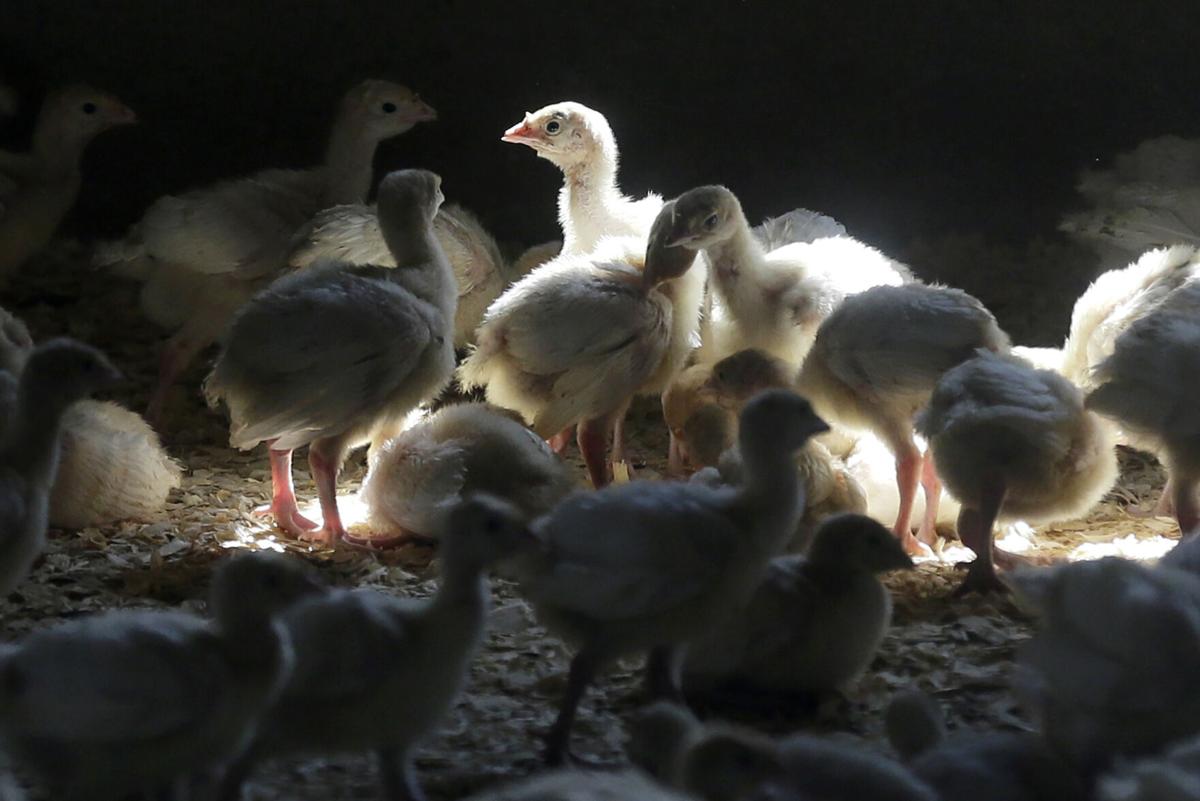
Turkeys stand up in a barn on turkey farm near Manson, Iowa on Aug. 10, 2015.
OMAHA, Neb. — The spread of a bird flu that is deadly to poultry raises the grisly question of how farms manage to quickly impale and dispose of millions of chickens and turkeys.
It's a chore that farms across the state are increasingly facing equally the number of poultry killed in the past two months has climbed to more than than 24 million, with outbreaks reported near every solar day. Some farms accept had to kill more than than 5 million chickens at a single site with a goal of destroying the birds inside 24 hours to limit the spread of the disease and prevent animals from suffering.
"The faster we can get on site and depopulate the birds that remain on site, the improve," Minnesota State Veterinarian Beth Thompson said.
The outbreak is the biggest since 2015, when producers had to kill more than than 50 1000000 birds. And then far this twelvemonth, there accept been cases in 24 states, with Iowa the hardest hit with about thirteen million chickens and turkeys killed. Other states with sizable outbreaks include Minnesota, Wisconsin, S Dakota and Indiana.
People are also reading…
Farms faced with the need to kill so many birds plow to recommendations by the American Veterinarian Medical Association. Even equally it has developed methods to kill the poultry rapidly, the association acknowledges its techniques "may not guarantee that the deaths the animals face up are painless and distress free." Veterinarians and U.S. Department of Agriculture officials also typically oversee the process.
Ane of the preferred methods is to spray h2o-based firefighting cream over birds as they roam around the ground inside a befouled. That foam kills the animals by cutting off their air supply.
When foam won't work considering birds are in cages above the ground or it's too common cold, the USDA recommends sealing up barns and piping carbon dioxide inside, offset rendering the birds unconscious and ultimately killing them.
If i those methods won't work because equipment or workers aren't available, or when the size of a flock is too big, the association said a last resort is a technique chosen ventilation shutdown. In that scenario, farmers finish airflow into barns, which raises temperatures to levels at which the animals die. The USDA and the veterinary association recommend that farmers add together additional oestrus or carbon dioxide to barns to speed up the procedure and limit suffering by the animals.
Mike Stepien, a spokesman for the USDA's Animal and Plant Health Inspection Service, said the techniques are the best options when it's necessary to rapidly kill so many birds.
"State animal health officials and producers advisedly counterbalance the different options to determine the all-time option for humane depopulation and do not make such decisions lightly," Stepien said.
Non everyone agrees.
Animal welfare groups argue that all these methods for speedily killing birds are inhumane, though they are particularly opposed to ventilation shutdown, which they note can take hours and is akin to leaving a dog in a hot machine. Creature rights groups delivered a petition terminal year signed by 3,577 people involved in caring for animals, including most 1,600 veterinarians, that urged the veterinarian clan to finish recommending ventilation shutdown every bit an option.
"Nosotros take to do improve. None of these are adequate in any fashion," said Sara Shields, manager of subcontract creature welfare science at Humane Society International.
Opponents of the standard techniques said firefighting foam uses harmful chemicals and it essentially drowns birds, causing chickens and turkeys to suffer convulsions and cardiac arrest as they die. They say carbon dioxide is painful to inhale and detectible by the birds, prompting them to try to flee the gas.
Karen Davis, of the nonprofit group United Poultry Concerns, urged the veterinarian association to finish recommending all of its three main options.
"They're all ways that I would non choose to die, and I would not choose everyone else to die regardless of what species they belong to," Davis said.
Shields said at that place are more humane alternatives, such as using nitrogen gas but those options tend to exist more expensive and could take logistical challenges.
Sam Krouse, vice president of Indiana-based MPS Egg Farms, said farmers experience miserable about using any of the options.
"We cascade our lives and livelihoods into taking care of those birds, and it'due south merely devastating when we lose any of those birds," Krouse said. "Everything that we're doing every twenty-four hours is focused on keeping the disease out and making sure that we're keeping our hens as prophylactic as possible."
Officials emphasize that this virus that's spread primarily through the droppings of infected wild birds doesn't threaten food safety or represent a pregnant public health threat. Ill birds aren't allowed into the nutrient supply and properly cooking poultry and eggs kills whatsoever viruses that might be nowadays. And wellness officials say no human cases of bird flu have been found in the United States during this current outbreak.
Once poultry are dead, farmers must quickly dispose of the birds. They usually don't want to gamble the run a risk of spreading the virus by transporting the carcasses to landfills, and so crews typically pile the birds up into huge rows within barns and combine them with other materials, such every bit ground up corn stalks and sawdust to create a compost pile.
After a couple weeks of decomposition, the carcasses are converted into a material that can exist spread on cropland to help fertilize crops. In some cases, carcasses are buried in trenches on the farm or incinerated.
Photos: 2020 in pictures from the On Wisconsin column
Brewers Spring Preparation

A pair of fans watch Milwaukee Brewers pitcher Brent Suter work on his pitches in the bullpen during a spring preparation game March 7 against the Texas Rangers at American Family unit Fields of Phoenix. Suter had already pitched in the game and in two innings of relief had given upwardly v runs on six hits, walking two and striking out one. Suter returned to the pitcher to work with a pitching coach.
Brewers Spring Preparation

The Phoenix Sonoran Preserve is an open desert park with miles of hiking and biking trails on the north side of the urban center.
Brewers Spring Grooming

American Family Fields of Phoenix is a multi-field circuitous that is used year-round by the Milwaukee Brewers but in Feb and March is home to bound grooming. This practice field was used prior to a spring training game confronting the Texas Rangers for the Brewers to stretch and warm upwards earlier making their way into the side by side main facility that seats about 10,000 fans.
Brewers Jump Training

Fans make their way into the American Family Fields of Phoenix, a baseball game circuitous owned by the city of Phoenix and used by the Milwaukee Brewers for yr-round baseball activities, including leap training.
Brewers Bound Grooming

Max Lazar, a bullpen who spent nigh of the 2019 flavor with the Wisconsin Timber Rattlers, the Milwaukee Brewers' Grade A minor league team near Appleton, makes his way by fans on March 7 at American Family unit Fields of Phoenix. Lazar went 7-4 last flavour.
Horse Deaths

Horses at Cerise Ridge Ranch Riding Stable most Mauston are on the mend afterward being sickened past toxic blister beetles that contaminated loads of hay purchased from out-of-state vendors.
Endeavor Sharing Supper

The kitchen at Attempt Uncomplicated Schoolhouse is a hive of activeness on the last Wednesday evening of each month as meals are readied for the Sharing Supper. Last week, volunteers -- from left, Patti Pulver, Cheri Gibeaut, Linda Krueger and Shirley Scherbert -- plated Salisbury steak, mashed potatoes, gravy and corn for the meal designed to promote civility and community.
Endeavor Sharing Supper

Linda Wade prepares drinks to serve during a monthly customs supper at Endeavor Elementary School in Try, Wis., Wednesday, January. 29, 2020. AMBER ARNOLD, State JOURNAL
Endeavor Sharing Supper

Doug Dewsnap, right, thanks Shania Barron for serving block with the help of Kai Stahler as members of Scouts BSA from Portage help with the Sharing Supper.
Endeavor Sharing Supper

Patti Pulver, left, and Kathy Thiemke bring in food from B&B Hitching Postal service in Portage for a monthly community supper at Endeavor Simple School.
Attempt Sharing Supper

About 160 people attended concluding calendar week's Sharing Supper in Try, a Marquette Canton village of virtually 450 people.
Endeavor

This customs was founded in 1891, but a bypass has diverted traffic around the Marquette County village, located almost nine miles north of Portage. Once a calendar month, a costless supper is held at the Effort Unproblematic School in an attempt to promote community togetherness while the library in 2020 is jubilant its 50th anniversary.
Alexian Brothers Novitiate

It would likely take millions of dollars to restore the mansion of the former Alexian Brothers Novitiate near Gresham.
Alexian Brothers Novitiate

Bruce Gallagher shows off the onetime conservatory room of the dilapidated mansion that at one fourth dimension was part of the Alexian Brothers Novitiate near Gresham. Gallagher is a Hartland Realtor charged with selling the mansion and the 181-acre celebrated Shawano Canton property that includes more than than four,000 feet of frontage along the Red River.
Wisconsin Big True cat Rescue & Instruction Centre

Wisconsin Big True cat Rescue owner Jeff Kozlowski interacts with BamBam, an African lion born in 2004 and ane of his starting time large cats. The nonprofit, located on 30 acres in the Sauk County village of Stone Springs, has 20 tigers, lions and leopards, and 1 Canada lynx.
Wisconsin Big True cat Rescue & Education Heart

Minocqua and Kai, a pair of 3-twelvemonth-quondam Bengal tigers, share an enclosure at Wisconsin Large Cat Rescue in Rock Springs. The 500- to 600-pound animals swallow twenty to 25 pounds of meat per twenty-four hours during the winter and 12 to 15 pounds per twenty-four hour period in warmer months.
A line-fishing opener amongst COVID-19

Buckets of bobbers and peg boards of baits are neatly organized equally Bella, a 7-twelvemonth-former border collie, relaxes at Kate'southward Bait due north of Dodgeville.
A angling opener amongst COVID-nineteen

Kate Mosley, owner of Kate'southward Bait & Sporting Goods near Dodgeville, has a vending machine that dispenses night crawlers, live minnows, hooks, bobbers and line-fishing lures for customers who prove upwardly after hours.
A fishing opener amid COVID-19

At Kate's Bait & Sporting Goods north of Dodgeville, possessor Kate Mosley is seen through her new walk-up window, which has been equipped with a doorbell. On the inside she has a stool and credit bill of fare reader, and will take orders for bait and tackle, turkey hunting supplies and other items. Mosley is trying to stay above h2o as nearby lakes are airtight and many gunkhole ramps on the Wisconsin River are barricaded due to the COVID-19 coronavirus pandemic.
Kickapoo Valley Reserve

Ron Johnson, the only chairman of the management lath for the Kickapoo Valley Reserve for 25 years, is retiring from the board this month. Since 1970, Johnson, 73, has lived adjacent to the 8,600-acre Vernon County property that features the Kickapoo River, valleys, ridges, primitive campsites, a visitor eye and trails for hiking, horseback riding and biking.
Kickapoo Valley Reserve

Ron Johnson, chair of the direction board for the Kickapoo Valley Reserve, shows off a classroom that is housed in a traditional Ho-Clamper shelter. The classroom is used year-round equally part of the KVR's pedagogy program that serves about 5,000 students annually.
Kickapoo Valley Reserve
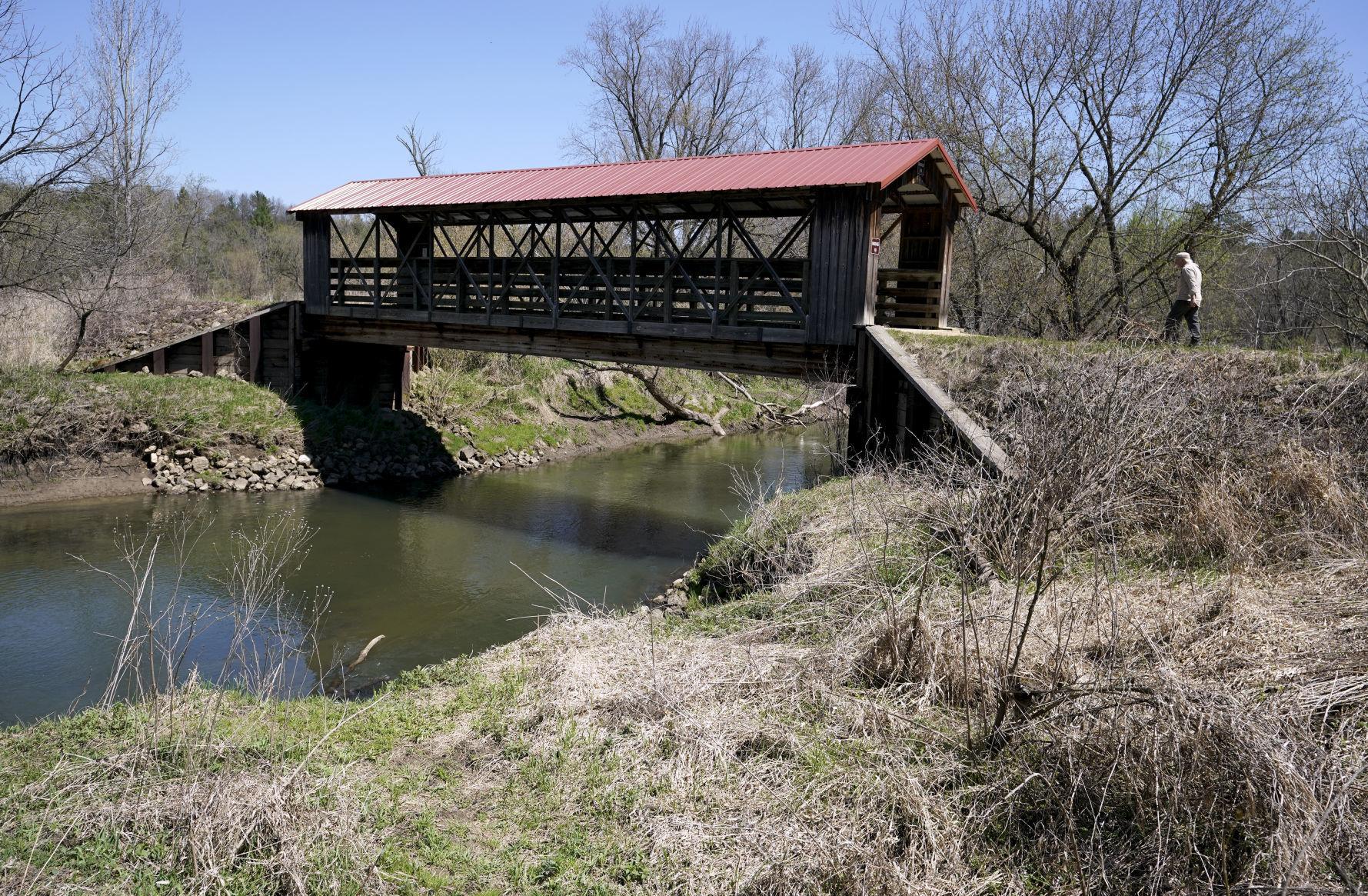
One of three covered bridges that cross the Kickapoo River in the Kickapoo Valley Reserve.
Kickapoo Valley Reserve

A concrete tower that would have been used to funnel high h2o from a proposed lake is one of the reminders of a failed plan to alluvion the Kickapoo River Valley north of La Farge. Millions of dollars were spent on the projection, including the partial construction of an earthen dam to hold back the flood-prone Kickapoo River. The valley is now home to the Kickapoo Valley Reserve.
Kickapoo Valley Reserve

A large section of Weister Creek, a tributary of the Kickapoo River, has been restored and improved for trout fishing.
Morel mushrooms

Ron Machotka cooks upwardly morel mushrooms, that were frozen from terminal yr, as he waits for customers outside a onetime used car lot in Muscoda, Wis., Thursday, May 14, 2020. Bister ARNOLD, STATE Journal
Morel mushrooms

Tom Nondorf shows where morel mushrooms are weighed when brought in, inside the garage area of a former used car lot in Muscoda, Wis., Th, May 14, 2020. AMBER ARNOLD, STATE Journal
Morel mushrooms

Ron Machotka displays a mushroom call he made in Muscoda, Wis., Thursday, May xiv, 2020. Bister ARNOLD, State JOURNAL
Burger Night in Muscoda

Tom Nondorf, president of American Legion Mail service 85 in Muscoda, heads up a spring morel mushroom sale but in the summer is busy one time a month with a hamburger sale in the village'due south downtown. Proceeds from both fundraisers are used to support a variety of Legion programs, including flags on village streets.
World's largest refracting telescope

Centered inside a 90-foot diameter dome, the 1890s-era refracting telescope at Yerkes Observatory in Williams Bay towers over visitors. The Academy of Chicago before this year transferred ownership of the 123-year-old facility to the Yerkes Future Foundation, a preservation grouping that plans to restore, refurbish and reopen the historic research middle.
Ornate pattern

Yerkes Futurity Foundation committee members Chuck Ebeling, left, and Frank Bonifacic, heart, visit with Ed Struble, who has been the managing director of building and grounds at the Yerkes Observatory in Williams Bay, Wis. for nearly 30 years Wednesday, June 10, 2020. JOHN HART, State Periodical
Forty-eight acres on Lake Geneva

Members of the Yerkes Future Foundation explore the John Olmsted-designed grounds of the Yerkes Observatory in Williams Bay, Wis. Wednesday, June x, 2020. Recently, the Academy of Chicago transferred ownership of the 123-year-old facility to the foundation, a preservation group that plans to restore, refurbish and reopen the research center. JOHN HART, State JOURNAL
Planning for the future

Members of the Yerkes Time to come Foundation detect shade nether a big maple tree on a portion of the 48-acre John Olmsted-designed grounds of the Yerkes Observatory in Williams Bay. The threescore,000-square-foot facility, home to iii domes each with its own telescope, was constructed between 1894 and 1897.
Viewer's angle

Built in the 1890's, the telescope at the Yerkes Observatory in Williams Bay, Wis., seen Wednesday, June ten, 2020, is the largest refracting telescope in the world. Electrical components added in the 1960's are visible on the lower end of the 60-foot-long viewing tube. JOHN HART, State Journal
Tri-County Regional Airport

Ed Asmus, of Aurora, Illinois, fuels his 1973 Cessna 337G Skymaster during a stop last week at the Tri-County Regional Airport in Lone Rock. The airport typically sells xx,000 gallons of fuel a twelvemonth. Simply as of last week, but 2,600 gallons had been sold this year.
Tri-County Regional Aerodrome

Juliet Hein, daughter of Piccadilly Lilly owner Jessica Hein, offers water to pilot Ed Asmus upon his inflow from Aurora, Illinois, at the Tri-County Regional Airport. The eating house is a big reason why pilots similar Asmus fly to Lone Rock.
Tri-County Regional Airport

Piccadilly Lilly Diner possessor Jessica Hein works in the dining expanse of the pocket-size restaurant adjacent to the Tri-County Airdrome in Lone Rock, Wis. Tuesday, June 30, 2020. The business organisation has been operating as a carryout enterprise but since the coronavirus pandemic took hold in the region in the spring. JOHN HART, Country Journal
Tri-County Regional Drome

Jessica Hein, owner of the Piccadilly Lilly Airport Diner, shares a booth with Jackson Evans, 4, every bit she waits for customers at her small restaurant at the Tri-County Regional Drome in Alone Rock. Hein rents the space for $200 a calendar month.
Tri-County Regional Airport

Marc Higgs, managing director of the Tri-County Regional Drome in Lone Rock, looks over a taxiway that was partially submerged concluding week, several days after rains moved through the area. Flooding has become more mutual at the drome and officials are studying means to reduce the negative effects of heavy rainfall.
Indian Lake Oak Savanna

Invasive trees harvested by crews working at Indian Lake Canton Park to preserve an oak savanna volition be used for fence posts, pallets, firewood and planks.
Indian Lake Oak Savanna

A large oak tree rises over Shane Otto, a land restoration specialist with Dane County Parks, in a restored area of oak savanna at Indian Lake County Park in the town of Berry.
Indian Lake Oak Savanna

Owen Detweiler, 33, owner of Valton Log & Lumber in Wonewoc, operates a grapple-skid to remove felled trees in an endeavor to restore an oak savanna at Indian Lake County Park.
Indian Lake Oak Savanna

Ruben Mazelin, 23, of Hillsboro, was drenched in sweat concluding week as he used a chainsaw to remove invasive hardwoods from a hillside at Indian Lake County Park.
Merrimac Ferry Landing Concessions

Visitors to Merrimac Ferry Landing Concessions gather at the window to guild up water ice cream. On a busy mean solar day the store can sell more than 500 cones and dishes of ice cream.
Merrimac Ferry Landing Concessions

Water ice cream at Merrimac Ferry Landing Concessions is hand-scooped past owner Adam Gallus, who works seven days a calendar week from Memorial Day through October.
Lake Wisconsin

St. Norbert Catholic Church

Church building leaders, construction workers and an architect talk last calendar week earlier climbing the scaffolding to audit the on-going renovation work at St. Norbert Catholic Church building in Roxbury.
St. Norbert Cosmic Church

Father Jerry Zhanay of St. Norbert Catholic Church in Roxbury has helped guide his congregation over the last four years but the past 3 years take included fundraising efforts for an exterior renovation project. The sanctuary of the church is non part of the projection but holds an historic 10-foot by six-human foot painting given to the church in 1849 by King Louis II of Bavaria. The painting hangs above the church altar.
Roxbury Church 12-08062020163638

Scaffolding surrounds the steeple of St. Norbert's Catholic Church in Roxbury, Wis. as an exterior renovation to the church continues Thursday, Aug. 6, 2020. JOHN HART, State Periodical
Roxbury Church building x-08062020163638

Masonry workers continue restoration of the steeple of St. Norbert's Catholic Church in Roxbury, Wis. Thursday, Aug. 6, 2020. JOHN HART, STATE JOURNAL
St. Norbert Catholic Church

Father Jerry Zhanay, left, and Marker Maier, a member of the St. Norbert Catholic Church renovation commission, had a prime view last calendar week of rural Dane and Sauk counties from the tiptop of the scaffolding that has encased the Roxbury church'due south steeple. A $one.2 million renovation project that began this past leap is scheduled to be completed past this fall and is designed to help ensure that the church, the oldest Catholic parish in Dane County, remains open up.
St. Norbert Catholic Church

Father Jerry Zhanay of St. Norbert Catholic Church in Roxbury is guided terminal week on scaffolding near the bong belfry by Matt Hollman, a superintendent with Maas Brothers Construction, a Watertown company that has years of experience working on church renovation projects.
DNC Milwaukee (copy) (re-create)

Banners announcing the 2020 Democratic National Convention are displayed on street poles outside the effect'southward downsized secondary venue at the Wisconsin Center in Milwaukee.
DNC Milwaukee

Ernesto Ruiz, a Clean Sweep Administrator with the city of Milwaukee, works Th along a more often than not repose Northward Fourth Street virtually the Fiserv Forum, which had been scheduled to host the Autonomous National Convention this week. Instead, nearly of the downtown will be placidity, now that the convention has moved to a largely online issue. The few hundred people that do nourish volition be at the nearby Wisconsin Center.
Lower Wisconsin Riverway

(From left) Mike Mossman, an ecologist with the Friends of the Lower Wisconsin Riverway, Katie Beilfuss, outreach programs director of the Wisconsin Wetlands Association, and Mark Cupp, executive managing director of the Lower Wisconsin State Riverway Board, canoe the Wisconsin River in Muscoda, Wis., Thursday, Sept. 3, 2020. The Lower Wisconsin Riverway is now recognized equally a Wetland of International Importance by the United States and the Ramsar Convention on Wetlands. Bister ARNOLD, Country Periodical
Lower Wisconsin Riverway

Timm Zumm, with the Friends of the Lower Wisconsin Riverway, uses his phone to take a picture of a beaver dam at the Fish Trap Flowage west of Muscoda. The flowage is office of the rich variety of the Lower Wisconsin State Riverway.
Lower Wisconsin Riverway

Timm Zumm, with the Friends of the Lower Wisconsin Riverway, drives his boat on the Wisconsin River in Muscoda, Wis., Thursday, Sept. 3, 2020. Bister ARNOLD, STATE JOURNAL
Lower Wisconsin Riverway

Cactus at Bluish River Sand Barrens State Natural Area near Muscoda.
Lower Wisconsin Riverway

The 92-mile Lower Wisconsin Riverway is a prime destination for paddlers. Its diverse ecosystem has led the Riverway to be designated a Wetland of International Importance past the Ramsar Convention on Wetlands. Marker Cupp, left, executive director of the Lower Wisconsin State Riverway Lath; Katie Beilfuss, center, outreach programs director of the Wisconsin Wetlands Clan; and Mike Mossman, an ecologist with the Friends of the Lower Wisconsin Riverway, paddle a stretch of the river near Muscoda last week.
Lower Wisconsin Riverway

Timm Zumm, with the Friends of the Lower Wisconsin Riverway, picks upward litter at a sandbar on the Wisconsin River most Muscoda. The river tin exist heavily used by campers and solar day paddlers.
Bill Mattison

Bill Mattison ran away to join the circus in 1941. And while his career is heralded for sailing, he also makes museum-quality models of circus wagons, some of which are on display in his Madison home.
Beak Mattison

Bill Mattison in the neatly organized workshop in the basement of his Madison dwelling.
Bill Mattison

A tented circus display created by Nib Mattison continues to evolve in the basement workshop of his Madison domicile. For years he had a boat shop on Williamson Street where he built world-class sailboats and iceboats.
Neb Mattison

Elements of Nib Mattison's "Mattison Family Circus" creation are displayed at his Madison abode, including a detailed dining motorcar that even includes the prices of food. Hot dogs are 15 cents, hamburgers 25 cents and peanuts a nickel.
Bill Mattison

Bill Mattison built 14 "Honeybucket" iceboats that at 1 time were some of the fastest in the globe. In 1964, Mattison won the national Triple Crown Trophy for iceboating and even appeared in Time magazine. This photo of Mattison is displayed in his bedroom nearly other sailing mementos.
Northwoods Census

Jack Klein, left, and his neighbor, Phil Curle, chat in Klein'southward driveway in the town of Presque Isle about the challenges of doing demography work in northern Wisconsin. Homes can exist far apart, on long, narrow and unimproved roads, and cell phone service is often spotty.
Northwoods demography

Phil Curle, who lives in the boondocks of Presque Island in northern Vilas Canton, adjusts a sign in the windshield of the pickup truck that indicates he'south a demography worker. Curle has put on hundreds of miles in Wisconsin's Northwoods in an try to detect information on households, many of which are vacation homes.
Northwoods demography

Jack Klein walks upwardly to a gate at a private housing development in the boondocks of Presque Isle. He could legally walk around the gate only would have to walk several miles to reach the homes on his demography list.
Northwoods census

Classic white signs dot northern Wisconsin and help travelers observe remote homes and businesses. This collection is near the intersection of highways B and Chiliad northward of Bedrock Junction in the town of Presque Isle.
Door County amid COVID-xix

Terry Chier, owner of Door County Sunglass Company in Egg Harbor, said it was impossible to make up for half dozen weeks of lost sales when his business concern was airtight for much of April and May. Merely he met his adjusted sales projections for the remainder of the summer.
Door Canton amid COVID-xix

Lauren Schar, possessor of Fireside, a restaurant in downtown Egg Harbor.
Door Canton among COVID-19

An "open" sign greets visitors at Greens N Grains in Egg Harbor. Many Door County merchants say that if they can make it through the fall, they will survive for another season.
Door County amid COVID-19

Angela Luberger, a jeweler who co-owns Plum Bottom Gallery in Egg Harbor, said sales are downward this year simply have not decreased as much as she and her husband, porcelain artist Chad Luberger, had expected.
Door Canton among COVID-nineteen

This sign is near Sherwood Point in Door County.
Door County amid COVID-xix

The Ellison Barefaced Land Natural Area near Ellison Bay is a big draw for those looking to take in ane of the many dramatic views of Door County. Tourism officials say visitor spending is down most 20% in the county, much less than what was anticipated because of COVID-xix.
Door County amid COVID-xix

Looking towards the Strawberry and Chambers islands from Peninsula State Park.
Milwaukee Soldiers Home

Funding for the $44.5 meg Milwaukee Soldiers Home project has included state and federal historic taxation credits, land and federal low-income housing credits and private fundraising. The Alexander Co. has spent the past 2 years renovating the historic structures. In the case of Sometime Main, seen here, more 650 window and door openings received upgrades.
Milwaukee Soldiers Home

Vi historic buildings at the Milwaukee Soldiers Abode complex, including Old Principal, constructed in the tardily 1860s, are undergoing a $44.5 million renovation to house homeless veterans.
Milwaukee Soldiers Home

The Milwaukee Soldiers Home complex stands in contrast to neighboring Miller Park and its retractable dome.
Milwaukee Soldiers Abode

The clock tower of the erstwhile administration building of the Milwaukee Soldiers Home complex.
Deer season opener 2020

A deer hunter appears to exist napping shortly before noon Sat on the border of a field with southern exposure along Highway B in rural Sauk Canton. More than deer hunters were expected to accept part in this year's nine-day gun deer season every bit license sales are 9.v% over 2019. Virtually-perfect weather too allowed for comfort while hunting and for those who chose to snooze.
Deer flavor opener 2020

Paul Merline, right, bagged an 11-point buck on opening day of the nine-twenty-four hour period gun deer season on Saturday. He was hunting on country near his boondocks of Westward Bespeak dwelling in rural Columbia Canton with his blood brother-in-law, Bob Lee, a retired warden with the state Section of Natural Resources. Merline and Lee hung the deer in Merline's garage as they prepared to procedure the animal.
Deer season opener 2020

Cousins Ryan Farrell, left, and Andrew Farrell use a measuring stick to get the width of the rack of an viii-bespeak buck shot by Ryan's father, Brian Farrell, of Middleton. The trio were hunting only south of Patently Saturday morning and were entering the deer into the I-Diehl Tap'southward large cadet contest.
Deer registration

Daniel Crook, right, looks at a photo Dan Ruhland took of Crook'southward nine point deer last calendar week. Crook, of Sextonville, was hunting southwest of Spring Green, registered his deer electronically but brought it to the I-Diehl Tap in downtown Manifestly to show off. Ruhland is a bartender at the I-Diehl, which for years was a pop deer registration station.
Watertown Castle

Dianne Owens and Paul Elliott descend the main staircase of their castle-similar house in rural Jefferson County. The abode, located between Watertown and Johnson Creek, was built in 2008, but near of the interior was unfinished when the couple purchased it in July.
Watertown Castle

Dianne Owens and Paul Elliott purchased their castle-like habitation in July and have been busy ever since completing its construction.
Watertown Castle

Dianne Owens and Paul Elliott walk their two-acre property in Jefferson County that is home to their 11,000-square-foot firm that resembles a castle. Structure began in 2008 by another couple but came to a halt after one of them died unexpectedly. The home sat empty and unfinished for ix years earlier Owens and Elliott purchased the property in July.
Watertown Castle

This glaze of armor, dubbed Ted Knight, was purchased from a seller in La Crosse and is i of the centerpieces of the living room of Owens and Elliott.
Nib Stork

Writer and veterinarian Bill Stork enters a barn at the Haack family dairy farm in the town of Deerfield.
Bill Stork

Dairy farmer Ryan Haack, left, and writer and veterinarian Bill Stork share stories during a visit by Stork to the farm in the boondocks of Deerfield. Stork writes about the Haack family, and the farm is pictured on the encompass of the second of his 3 books.
Bill Stork

Ryan Haack, left, works long days on the family unit subcontract he operates in partnership with his male parent, Jim Haack, in the town of Deerfield simply looks forward to the regular visits from Bill Stork, correct, a Lake Mills veterinarian. Stork and Ryan Haack spend a lot of time talking almost writing, the need for naps, quilting and any other number of topics.
Bill Stork

Near a shed featuring manus paintings by immature members of the Haack family unit, writer and veterinarian Bill Stork prepares for a round of pregnancy checks on cows in the family unit's dairy herd. Stork came to Wisconsin in 1992 from Illinois and in 1994 purchased Lake Mills Veterinary Clinic.
Rotary Botanical Gardens Holiday Light Show

Kyle and Mary Ann Cook, of Janesville, take in the sights from a bench forth the path through the Rotary Botanical Gardens Vacation Light Show in Janesville.
Rotary Botanical Gardens Holiday Light Show

Visitors walk i of the many paths through the Rotary Botanical Gardens Holiday Light Evidence in Janesville. It takes xxx to 45 minutes to walk the half-mile route.
Rotary Botanical Gardens Holiday Light Evidence

With social distancing rules, at that place will be fewer visitors to this yr's Holiday Calorie-free Show at Rotary Botanical Gardens in Janesville, but the displays continue to grow. An estimated two meg lights cover much of the 20-acre gardens where visitors can walk the paths and take in the displays. The consequence is the largest fundraiser of the yr for the gardens, located in a onetime gravel pit.
POYArnoldWIChamberChoir-12142020221524

Brittany Pahnke, of Madison, sings into a microphone as she warms-up for the Wisconsin Chamber Choir's Car Carols concert from the roof of a parking garage at American Family unit Insurance in Madison, Wis., Sat, December. 12, 2020. Amber ARNOLD, Country Journal
Car Carols with the Wisconsin Chamber Choir

Director Robert Gehrenbeck, well-equipped for the December elements, uses a baton to comport Sat'southward Wisconsin Sleeping accommodation Choir concert.
Car Carols with the Wisconsin Sleeping accommodation Choir

Andi Becerra of Madison warms-up for the Wisconsin Chamber Choir's concert from the roof of a parking garage at American Family unit Insurance in Madison.
Automobile Carols with the Wisconsin Chamber Choir

The 40 members of the Wisconsin Chamber Choir performed from their cars and one pickup truck Saturday from the superlative of a parking garage at American Family Insurance.
Car Carols with the Wisconsin Chamber Choir

Caitlin Schmidt, left, sings from her festive Chevy Volt during Saturday's Auto Carols concert by the Wisconsin Chamber Choir at an American Family Insurance parking ramp.
Car Carols with the Wisconsin Bedroom Choir

Franzo Law Two, of Madison, sings tenor with the Wisconsin Sleeping room Choir during its Car Carols concert. Decorations were common on vehicles to help add to the holiday spirit.
Moon Rabbit

Occupying the site of the erstwhile Schuett's Drive-In, which had a presence in Watertown, Wis. for more than threescore years, Moon Rabbit now offers an eclectic bill of fare featuring dishes with national and international origins in Watertown.
Moon Rabbit

Moon Rabbit'due south Hammi Hamann works in the kitchen of the business she co-owns with her husband, Brent Hamann in Watertown.
Moon Rabbit

Jazz music is a abiding at Moon Rabbit, but the menu changes daily and represents the world. Information technology can include deep-fried catfish, smoked brisket, muddied rice, shawarma, Indonesian noodles and falafel. Moon Rabbit co-owner Hammi Hamann assists in the kitchen, but also runs the restaurant's social media.
Moon Rabbit

Moon Rabbit co-owner Brent Hamann prepares a pot of dirty rice in the kitchen of the business in downtown Watertown. Hamann grew up in the urban center, simply honed his cooking skills for 20 years in New Orleans.
Moon Rabbit

Brent and Hammi Hamann, owners of Moon Rabbit in Watertown, gear up the offerings for drive-up customers at their pop-up restaurant in the urban center's downtown. For more than 60 years the site was abode to Schuett's Drive-In, only in 2017 the Hamann's purchased the restaurant and radically altered the card.
Source: https://madison.com/business/grisly-question-of-bird-flu-how-to-kill-dispose-of-millions-of-poultry/article_8fa055d0-5aeb-5136-8c00-ee26e346551d.html
0 Response to "Mike Farrell Wildlife Art Publication Sales Hartland Wi"
Postar um comentário